

How To Specify Sending Email Address When Using Outlook Rules To Send A Template-based Message
 Working with message templates can be a great way to save some time composing emails or answering repeated requests. Outlook offers several methods to work with message templates to be more productive in any situation.
This guide discusses the various methods and offers some tips to get y'all started with.
- Quick Steps
- Quick Parts / AutoText
- My Templates Office Spider web Add together-in
- Insert as Text
- Drafts
- Oft-files
- Rules
- AutoCorrect
- Signatures
- Stationery
- Custom forms
- Add-Ins
Quick Steps
 Quick Steps allows you to define your own commands which performs 1 or multiple actions. Ane of these actions is to create a new electronic mail message, respond to a message or forward a message and predefine various fields such as the To and Discipline line merely also the bulletin body.
How to create?
To create a new Quick Step, you tin can click on the "Create New" link within the Quick Steps gallery on the Home tab. To create a new template bulletin, cull one of the following actions from the list;
- New Message
- Forwards
- Respond
- Reply All
- Reply With Meeting
- Forrard bulletin equally an attachment
By default, you'll merely encounter the "To…" line, but when y'all click on the Show Options link, yous can specify ane or more than of the post-obit fields;
- To
- CC
- BCC
- Field of study
- Follow Up Flag
- Importance
- Message Text
- Automatically ship later on i minute filibuster.
How to utilise my template?
Once you've created your Quick Step, it will automatically show in the Quick Steps gallery on the Dwelling house tab of the Ribbon. Just click on it to execute it.
When you lot want to change the template, actions, proper name or display icon, but right click on the Quick Stride and choose: Edit <your Quick Step proper name>.
Where is information technology stored?
Quick Steps are stored inside your mailbox. When you use an Commutation or Outlook.com business relationship, your Quick Steps will be available to y'all on all computers on which you have added your account to Outlook.
For backup instructions see; Backing upwards and Restoring Quick Steps

Overview of a Quick Step configured to reply to the currently selected message with average text and to mark the bulletin as read. The keyboard shortcut has been set up to CTRL+SHIFT+1.
Quick Parts / AutoText
 Quick Parts is the main characteristic to create and insert blocks of text. It is the successor of what used to be AutoText in Outlook 2003 and previous.
How to create?
When you commencement a new message you lot'll find the Quick Parts command under;
- Simplified Ribbon (Microsoft 365)
Insert-> ellipsis (…) push button on the correct-> Quick Parts - Classic Ribbon
Insert-> Quick Parts
To create one of your own, simply type your standard text in an email showtime. Later this, select your text and press ALT+F3 or choose;
- Insert tab-> Quick Parts-> Save Selections to Quick Role Gallery…
Quick Parts also back up formatting such as color, fonts, etc… and fields (Insert-> Fields…). This will let y'all for example to create templates which holds a reference to and highlights the current date or to mention a date which is x days into the future (e.g. to notify that the issue will be closed subsequently that date when no reply is received) without the demand to update this field manually.
To update a Quick Part later, yous'll accept to insert it in a bulletin beginning. Then make your changes to the Quick Part and save information technology with the same proper noun.
How to use my templates?
To insert a Quick Part, you select the Insert tab and click on the Quick Parts button. This will open a gallery with previews of Quick Parts to cull from.
Sadly the implementation of Quick Parts in Outlook isn't as consummate equally the implementation is for Give-and-take every bit it is not possible to assign keyboard shortcuts to a specific Quick Part. This takes some "quickness" abroad. To at least save y'all a click for selecting the Insert tab first, you lot tin add the Quick Parts Gallery to the Quick Access Toolbar (QAT) by right clicking it and cull Add to Quick Access Toolbar.
Another method to insert a Quick Function is to blazon its name (or at to the lowest degree the part until it gets unique when compared to the names of your other Quick Parts) and printing F3. In Outlook 2016 and later, y'all'll also get a popular-up proffer and and so you can press ENTER to insert it.
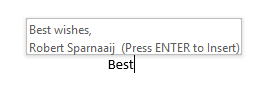
The Insert Quick Office proposition characteristic.
To gain access to the Edifice Blocks Organizer, you'll take to add information technology to the QAT equally well or right click any Quick Office from the list and cull "Organize and Delete…". This last option just works when the message format is set to HTML and non when it is set to Plain Text. For more details see this mail.
Where is it stored?
Quick Part entries are stored in the NormalEmail.dotm file.
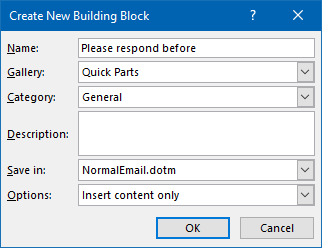
Plenty organizing options to sort and find dorsum your Quick Parts later.
My Templates Office Web-Add together-in
 The My Templates Office Web Add-in is available when you are using Outlook 2013, 2016, 2019 or Microsoft 365 with an Exchange 2013, 2016, 2019 or Substitution Online (Microsoft 365 for Business organization/Enterprise) or Outlook.com business relationship.
It lets you create templates that include text and images. Templates that you create with My Templates are non just available in Outlook but besides in Outlook on the Spider web (OWA).
How to create?
Before creating your first template, you must first enable the Spider web Add-in. To do this, select the Get Add-Ins or Office Add-Ins command on the Abode tab of the Ribbon. This will open a dialog from which you lot can enable and add the My Templates add together-in.
When composing a message, you tin can open the My Templates pane in the following mode;
- Simplified Ribbon (Microsoft 365)
Dwelling house-> ellipsis (…) push on the right-> View Templates - Classic Ribbon
Home-> View Templates
This will open the My Templates pane on the correct of the message where you lot can ascertain templates of your ain. Y'all can paste copied images into these templates as well.
How to use my templates?
Once y'all accept the My Templates pane opened in Outlook, yous tin can but click on whatsoever template to quickly insert information technology.
In Outlook on the Web and Outlook.com, you can find the My Templates button in the bottom right corner below your Bulletin Etch section but you may need to press the ellipsis (…) button to actually come across it.
Where is is stored?
Your templates are stored within your mailbox so they are likewise available to you when you are using another computer or Outlook on the Web.
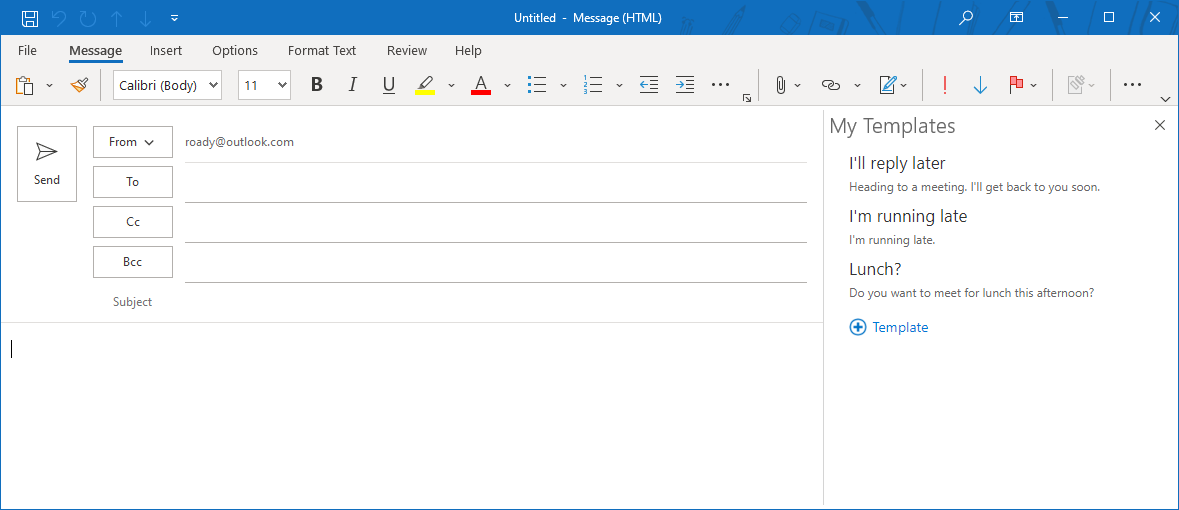
The My Templates Office Web Add together-in is simply bachelor when y'all are using an Commutation account.
Insert equally Text
 Insert as Text is an pick which volition let you to directly insert the contents from some other text based document into an email without needing to open up that document offset and copy and paste the text manually from the document into the email.
How to create?
Equally this is file based, all you take to practice is create a file with the contents of your template. Quite a few text based document formats are supported such equally txt, htm, html, rtf, medico and docx. This will permit you to also contain formatting such as color, fonts, etc… in your templates. Because of the HTML support it will also allow you to inject HTML direct into the message body which can be handy for newsletter templates for example.
How to use my templates?
This feature works almost the same equally inserting an attachment;
Click on the paperclip icon while composing a bulletin and scan to a text based certificate. Instead of directly clicking on the Insert push, click on the little down pointer on the Insert push and choose Insert as Text.
In Outlook 2016, Outlook 2019 and Microsoft 365, this choice has been hidden but tin exist made bachelor once again by adding the classic Adhere File command to your Quick Admission Toolbar (QAT) or Ribbon.
As the Insert as Text option is based on attaching a file, by default it will open up to your Documents folder. To rapidly jump to the location where you shop your templates, y'all can add the location to your File Explorer Favorites or Role Favorites.
Where is it stored?
You can store the files anywhere y'all like. For case, if you go on your documents on the D:\ bulldoze yous could locate them in a logical sub folder such as;
D:\Documents\Outlook\Templates
The Insert as Text option is a nifty solution if you demand to share your blocks of texts. The text-files can exist stored on a network share (and additionally sorted in sub folders) and so they can be accessible by anybody in your squad and updates to them will reflect to everyone else this manner.
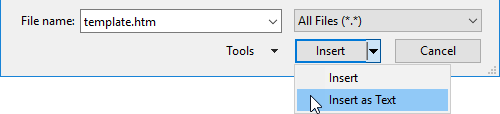
Directly inject some text or HTML code into your bulletin via Insert every bit Text
Drafts
 Drafts are unsent Outlook letters that are saved inside of Outlook.
How to create?
When basically the unabridged message is role of your message template, then creating a draft bulletin that you can reuse is a good way to go. You compose the bulletin one time in Outlook and and then press the Save button so information technology volition be stored in your default Drafts folder in Outlook.
Y'all can also predefine the subject area, or whatever of the Address Fields. If you have multiple accounts configured, you can even predefine the sending account every bit well without the need for whatsoever programming.
How to use my templates?
When opening a draft from within Outlook, Outlook considers information technology to exist a continuation of the original bulletin. This ways that the message will be removed from your Drafts folder after sending it. Therefore, you lot should either press the Forrard button subsequently selecting a draft or brand a re-create of the draft commencement before opening it. For more techniques, as well see; Keep a copy of a Draft equally a message template.
Where is it stored?
By default, drafts are stored in your Drafts folder. You tin can of class choose to create a separate Templates folder inside Outlook where you can store your template drafts. If you lot take many, yous could even organize them into subfolders or assign them categories.
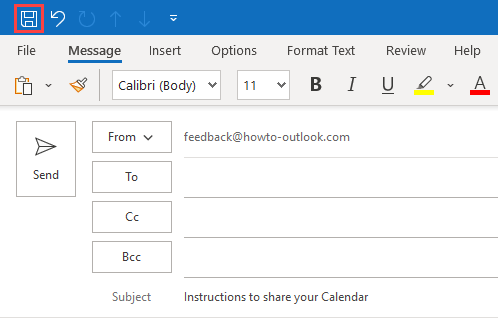
Saving a Draft bulletin as a Template within the Drafts folder of your mailbox.
Ofttimes-files
 Oft-files are unsent Outlook messages that are saved outside of Outlook.
How to create?
Similar to creating a Typhoon template, when basically the unabridged message is office of your message template, then creating an frequently-files is a proficient fashion to go. Yous etch the bulletin in one case in Outlook and so utilize the Relieve As… function to save it outside of Outlook as an often-file.
Yous tin can also predefine the subject, or whatever of the Address Fields. If you have multiple accounts configured, you lot can even predefine the sending account as well without the demand for any programming.
How to utilize my templates?
Often-files can easily be opened by double clicking information technology from the location where you stored information technology. For easy access to the template y'all tin can too create a shortcut to it in the Shortcuts Navigation or pin it to Outlook'southward Jump Listing.
Where is it stored?
For often-files it is basically the aforementioned story as where you can salvage the Insert every bit Text templates; You can save them anywhere y'all'd similar. However, when selecting *.ofttimes equally the Save As type, Outlook will default to your Templates folder.

Saving a Typhoon message as an Outlook Template (oft-file) outside of Outlook.
Rules
 Rules are designed to automate applying deportment to letters upon inflow. As they can likewise be run manually and reply to messages, it can also be used to reply to letters in bulk.
How to create?
The rule that you'll need to create for this method will require the post-obit criteria;
- respond using a specific template (when not using Exchange or when the message template is stored locally)
- accept server reply using a specific template (available just when using an Exchange server)
You can of course set additional actions and criteria merely it is not needed for this method. Make certain that after creating the rule, you disable information technology.
If you always want to reply directly to that message automatically then you lot'll have to fix some additional exceptions to prevent an endless post loop. An example for such a dominion can be constitute here.
How to use my templates?
It is best to first collect the messages that you desire to reply to in bulk in a single folder (this can be washed automatically via a separate rule). This will allow you to use the rule more than easily. For case, a lot of people emailed you with feedback and y'all want to thank them all at one time and want to inform them about the main feedback that you lot got and what yous are going to do with information technology.
Y'all can now manually execute this rule against the selected folder to ship the standard message to all the people who have replied to you lot with feedback;
- Open the Rules and Alerts dialog;
- tab Home-> button Rules-> Manage Rules and Alerts…
- Press the push button "Run Rules At present".
- Select the created template rule and brand certain all other rules are disabled.
- Use the Scan… button to prepare the binder to the binder where you stored all the feedback messages in.
- Press the push button Run Now.
Where is it stored?
The rule itself is stored within your mailbox.
When you lot created the rule with "accept server reply with a specific template" so the template is also stored in your mailbox equally a subconscious message.
When you created the rule with "reply using a specific template" and then the template is an oft-file which you lot are free to place anywhere that is most user-friendly to you.
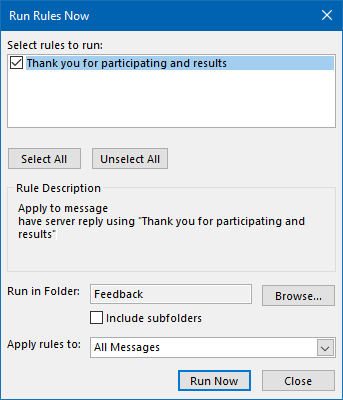
Reply to all letters in a unmarried folder at in one case.
AutoCorrect
 While AutoCorrect is not straight designed to insert template text, it does allow you to quickly insert template text via a specific keyword or acronym.
How to create?
Just like creating an AutoText or a Quick Role entry, you start with typing your template text first within a message. This may even comprise formatting. After you lot have finished typing, select your text and open the AutoCorrect dialog;
- File-> section Options-> department Postal service-> button Spelling and AutoCorrect…-> section Proofing-> button AutoCorrect Options…
Your template text will automatically be copied into the replacement text field.
Blazon your keyword and brand sure you select the "Formatted text" option to maintain formatting and/or to support entries larger than 256 characters.
How to employ my templates?
Using the templates is as easy as typing your keyword that you configured in AutoCorrect options. Equally soon as you hit the Spacebar or Enter key later inserting your keyword, AutoCorrect volition automatically supplant it with your template text.
Where is it stored?
Formatted AutoCorrect entries are stored within your NormalEmail.dotm file.
Non formatted AutoCorrect entries are stored inside a file called MSO####.acl where #### is replaced with the linguistic communication ID number for the file.
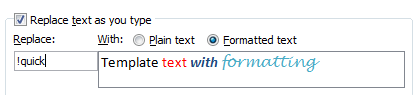
Save your AutoCorrect templates with formatting if needed.
Signatures
 Signatures are designed to insert a predefined text block at the stop of your email. In some cases these can likewise be used to insert text templates.
In general it is not recommended to use signatures to insert text templates unless they really are signatures. This is because you are not actually inserting a signature but you are actually switching the signature; when you select a different signature while composing, the default signature is removed and replaced by the one that y'all have selected.
How to create?
Signatures tin can exist created via;
- File-> section Options-> section-> Mail-> push Signatures…
For more about creating signatures see this more specific Signatures guide.
How to apply my templates?
To select/add your signature utilise;
- From the Include department of the Bulletin tab press the Signature button to come across your defined signatures.
- When you select a signature when one is already added to your email, the signature will be swapped and non included as a second signature.
Where is it stored?
Signatures are stored in 3 file formats (.txt, .htm and .rtf) in the Signatures folder. For easy access to this folder, hold the CTRL (Control) button on your keyboard while pressing the Signatures… button in the Options dialog mentioned above. This will directly open the folder in Explorer.
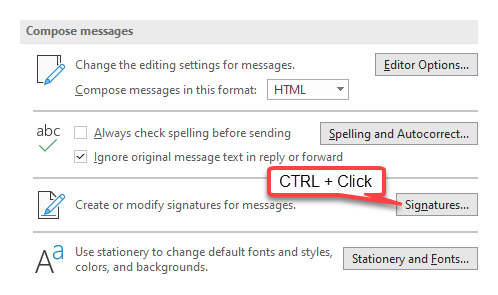
Past clicking the Signatures button, you can create new and manage your electric current Signatures. By belongings the CTRL push while clicking the Signatures button opens the Signatures folder in File Explorer.
Stationery
 The stationery characteristic of Outlook is used to decide your design when composing a new email.
How to create?
Stationery files are HTML based. Instead of but defining a layout, a background and a header in your HTML template, y'all tin can also decide to only include text. When you at present would use that Stationery, that text is automatically loaded into your message torso.
How to utilise my templates?
Stationery files first need to exist stored in your Stationery folder (meet below). Once yous've done that, you lot tin can select them in the post-obit way;
- Simplified Ribbon (Microsoft 365)
Home-> downwards arrow on New Electronic mail button-> E-mail Message Using-> More Jotter… - Classic Ribbon
Home-> New Items-> E-mail Message Using-> More Stationery…
Where is it stored?
Jotter is stored in htm format in your Stationery folder;
C:\Users\%username%\AppData\Roaming\Microsoft\Stationery
For like shooting fish in a barrel admission to this folder, hold the CTRL (Control) button on your keyboard while pressing the Stationery and Fonts… push in the Options dialog mentioned below. This will directly open up the Jotter folder in Explorer;
- File-> Options-> Mail-> button: Jotter and Fonts…

Start a new message based on Stationery with default text.
Custom Forms
 A "form" is basically the design and the function of the fields when you lot open or create a new Outlook items such every bit a bulletin, appointment or contact. You can design these yourself as well.
How to create?
You can pattern these layouts yourself as well via the Form Editor in Outlook. Using them is a bit more than complicated equally the other methods mentioned in this guide as it (often) requires boosted programming just it if y'all become passed that it can be one of the virtually powerful solutions likewise.
To kickoff the blueprint of a new message template you can use;
- Enable the Developer tab
File-> Options-> Customize Ribbon-> in the right pane, enable the choice field before "Developer"-> press OK to return to Outlook. - Once enabled, select the Developer tab and cull: Design a Form

The Developer tab needs to be enabled first.
If you are interested in designing and programming your own forms the following links will get you lot started. Some are a bit outdated just so is the Custom Forms characteristic and then most of it will still apply.
- Create an Outlook Grade
- Publish a Grade
- Developing Custom Forms Using Microsoft Outlook 2002 (Part 1 of two)
- Developing Custom Forms Using Microsoft Outlook 2002 (Part 2 of 2)
- Using contact item selector fields
- Changes to custom properties in Outlook
Microsoft used to offer a whole list of custom forms which you could use directly or customize into your own solution. As these are very old (most were created in the Outlook 97/98 period), some of them still work every bit they were intended way back then though. Some good forms to get you lot started are the While y'all were out form and Holiday Request course.
How to utilize my templates?
Selecting a custom class can exist washed via;
- Simplified Ribbon (Microsoft 365)
Home-> down pointer on New Email button-> More Items-> Cull Form… - Classic Ribbon
Abode-> New Items-> More Items-> Choose Form…
Where is it stored?
Custom forms tin be saved as oft-files via the Relieve As… option then y'all are gratis to choose a location which is nigh convenient to you. The location defaults to your Templates folder.
Custom forms can too be published within a specific folder in Outlook or to the Organizational Forms Library. In that case they are stored as a subconscious message within your mailbox or the Public Folder. When your class contains code, they must be published instead of saved as an oftentimes-file for the code to run.
- While designing your form-> Developer tab-> push Publish-> Publish Course As…
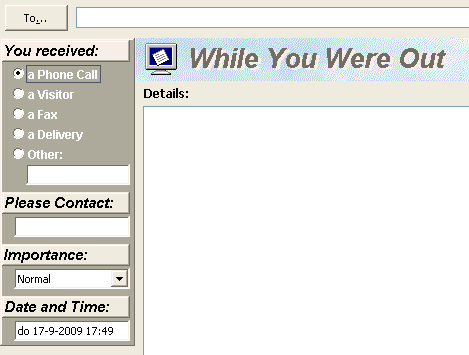
The While You Were Out form might exist quondam but is still useful.
Add-ins
 Below is a list of third party template tools which yous tin can use in addition to the existing template features or as a replacement of it. I won't talk over their first to finish processes only will highlight their unique features.
Quick Templates by MAPILab
- Quickly insert a specific template via a pre-defined Hotkey (up to 26).
- Supports font formatting.
- Generate templates from text selections.
- Easily accessible on the main Message tab in the Ribbon.
- Discount lawmaking 4PM76A8
Quick Text Hotkeys past Sperry Software
- Chop-chop insert a specific template via a pre-defined Hotkey (not just via letters but as well via the function keys and with combinations of CTRL, SHIFT and/or ALT).
- Back up for date and time variables in different display formats.
- Besides can be used when creating contacts, appointments, tasks, notes and journal items.
- Hands backup and restore your created templates to share your templates or to restore them after a reformat or installation on a new calculator.
- Disbelieve code BH93RF24
Email Templates by Agave Software Inc
- Special button to direct initiate a reply with specific template text.
- Support for variables to resolve backdrop of the message you are replying to or from your contact data.
- Back up for prompts to chop-chop insert some unique values into the template text.
For instance, include a username and password in an introduction electronic mail without needing to look upwardly their insertion points inside the email. - Supports public and individual templates which can be stored in your ain mailbox or Public Folders.
- Discount code: RSPA-WKGG
Bells & Whistles for Outlook by DS Evolution
- Full formatting support for templates, including images.
- Categorize your templates and/or quickly insert a specific template via a pre-defined Hotkey (upwardly to 21).
- A template tin can also automatically readdress (add or remove recipients) the emails or modify the subject.
- Automatically insert a greeting when replying to messages (also supports retrieving data from contact information such every bit nicknames).
- Include or quote the names of the original attachments.
- Many more than additional features such equally adding notes to letters, automatically null outgoing attachments, empty subject alert, forgotten attachment warning, reply to all alert, always reply in Plain Text or HTML, automatically mail service merge when addressing mails via the Bcc field and still fifty-fifty more…
For more templates add together-ins run into the Templates section of our add-in database.

How To Specify Sending Email Address When Using Outlook Rules To Send A Template-based Message,
Source: https://www.howto-outlook.com/howto/messagetemplates.htm
Posted by: wiedmanmillopeat1966.blogspot.com
0 Response to "How To Specify Sending Email Address When Using Outlook Rules To Send A Template-based Message"
Post a Comment